Surveillance Cameras Can Now Be Retrofitted to Track Your Wireless Device Fingerprint

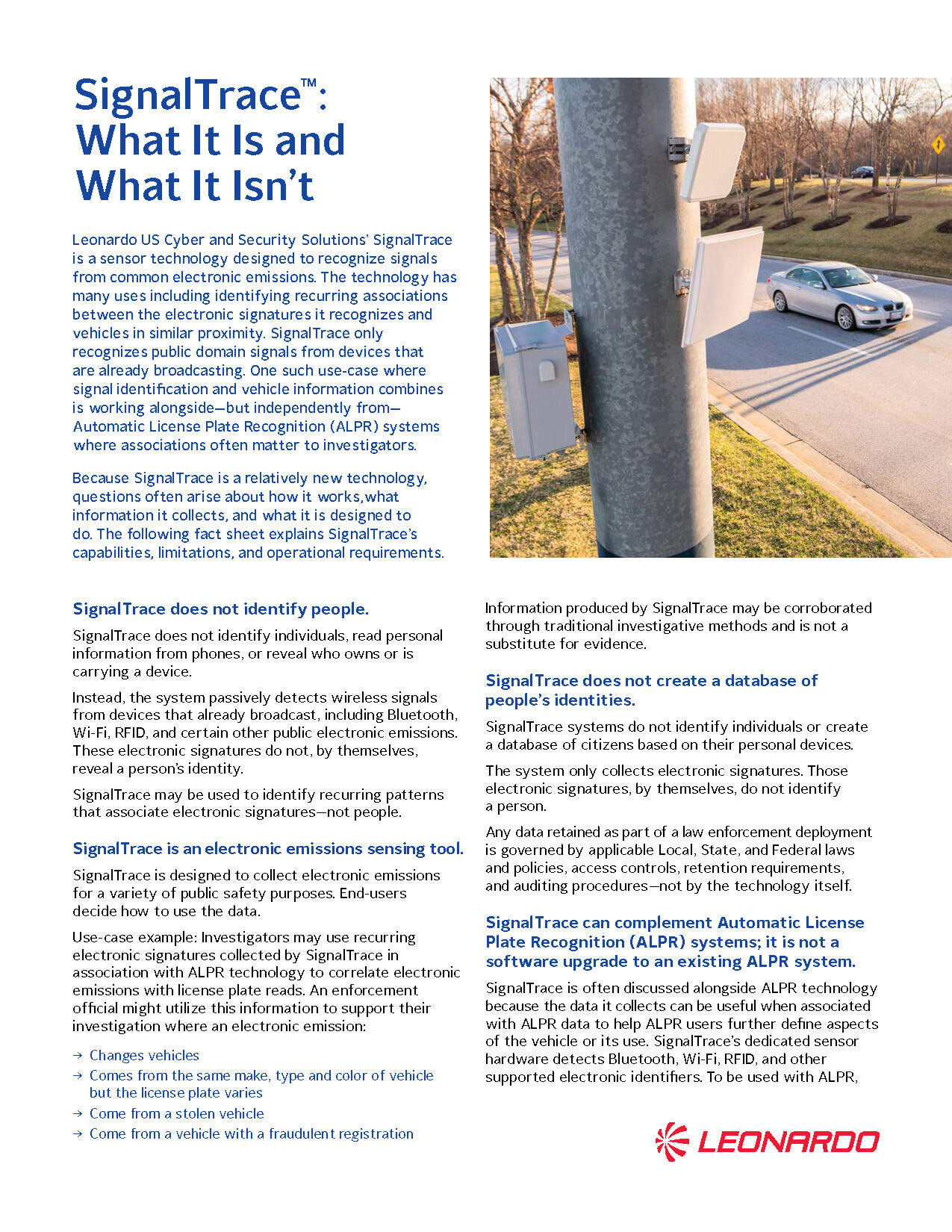
Flock-style license plate reader vendor Leonardo announced a new system called SignalTrace that can fingerprint your wireless devices while you drive by and track you around without needing to see your license plate.
All wireless devices emit electromagnetic signals in order to communicate. These signals can often be uniquely fingerprinted based on differences in the analog hardware components due to differences in manufacturing between devices.
When you travel in your car, your smartphone, your smart watch, wireless headphones, and even your car's infotainment system are usually outputting a constant stream of RF emissions. When all of these individual devices are traveling together, it's likely to be the same person.
SignalTrace promises to utilize this data to try and more accurately track people while they drive when the license plate number is not known.

It can even track RFID devices such as credit cards, something that usually only works at short range.
The new devices can be retrofitted onto preexisting license plate reader cameras and are meant to work alongside them, storing your device fingerprint alongside your license plate number in a centralized database that police can access at any time.
One of the most terrifying things about this is that it not only identifies your car, but tries to identify individual people inside the car. For example, if two people are riding together, it can detect each person's individual fingerprint separately.
This also means these readers can now work even if you don't drive. Simply walking or biking close enough will likely mean your unique RF fingerprint is now stored in some database and your movements can be tracked.
Laughably, Leonardo tries to advertise that their system "respects individuals' privacy rights" because the actual data itself isn't decrypted or read. This is definitely an example of metadata being more useful than the content.
In a separate page solely dedicated to assuaging fears, they try to argue it doesn't identify people but just electronic signatures. However in their promotional material they claim it can identify suspects by the electronic devices they use, which is a clear contradiction.
The fact of the matter is that when all sources of RF on your person are combined, including RFID chips like the ones in your credit cards or even smart card from work, it's unlikely that anyone else will have the same fingerprint as you and that's the entire point.
Community Discussion